
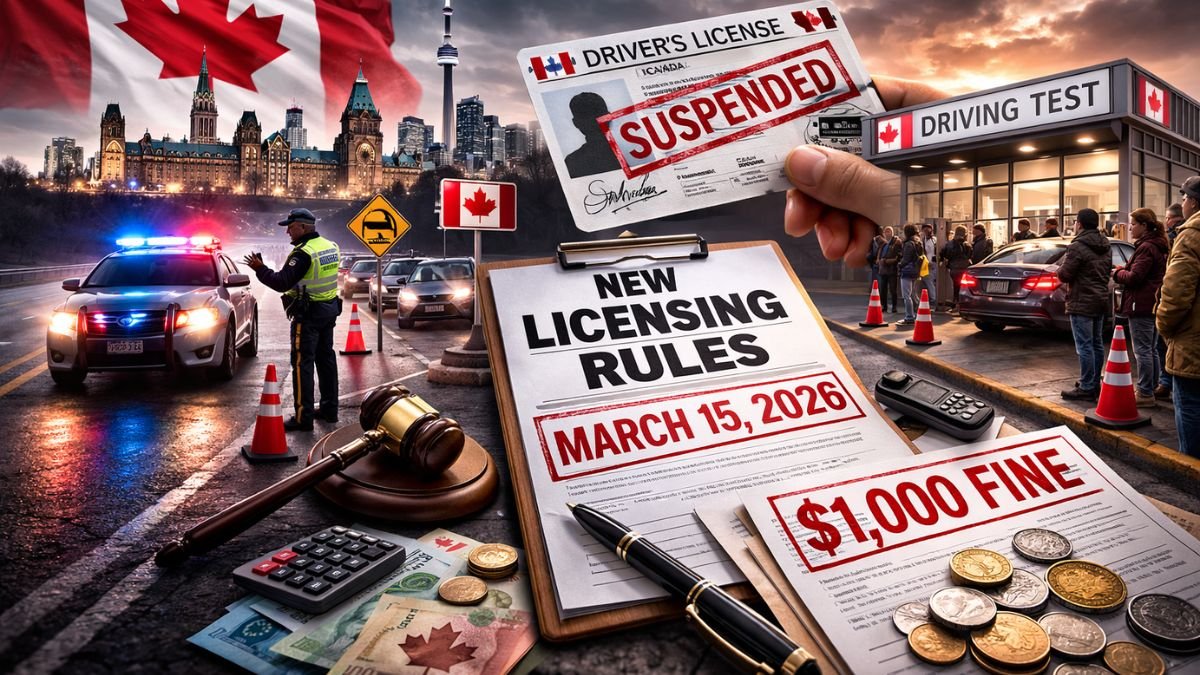
Across Canada, driving regulations continue to evolve as governments aim to improve road safety and reduce risky behavior among new drivers. A recent policy update titled Canada Tightens Licensing Laws on 15 March 2026 With $1,000 Fines and Suspensions highlights new enforcement measures that could affect thousands of drivers, particularly those in graduated licensing programs.
New penalties introduced under the updated laws
$1,000 fines for serious violations
Under the policy described in Canada Tightens Licensing Laws on 15 March 2026 With $1,000 Fines and Suspensions, authorities may impose fines of up to $1,000 for serious offences involving new drivers.
These violations may include:
- driving while distracted
- ignoring graduated licence restrictions
- excessive speeding
- dangerous driving behavior
Higher fines are expected to serve as a strong deterrent.
Licence suspensions for repeat offences
Another important aspect of Canada Tightens Licensing Laws on 15 March 2026 With $1,000 Fines and Suspensions is the introduction of stricter suspension rules.
Drivers who repeatedly violate licensing restrictions could face temporary suspension of their driving privileges. The length of the suspension may vary depending on the severity of the violation and the driver’s record.
In some cases, drivers may also be required to restart parts of the graduated licensing process.
Who will be affected by the new rules
New and young drivers
The primary group affected by Canada Tightens Licensing Laws on 15 March 2026 With $1,000 Fines and Suspensions includes individuals who are currently in the learner or probationary stages of licensing.
These drivers typically have less experience behind the wheel and are statistically more likely to be involved in accidents.
The new measures aim to reduce these risks by enforcing stricter accountability.
Drivers violating licence conditions
Any driver who fails to follow the conditions attached to their licence could face penalties under the updated regulations.
For example, driving outside permitted hours or carrying too many passengers during the probationary stage could result in fines or suspension.
Simple table explaining Canada Tightens Licensing Laws on 15 March 2026 With $1,000 Fines and Suspensions
| Topic | Simple Explanation | What it Means |
|---|---|---|
| Canada Tightens Licensing Laws on 15 March 2026 With $1,000 Fines and Suspensions | New driving rules with stronger penalties | Drivers must follow licence rules carefully |
| Who is affected | Mostly new drivers in graduated licensing programs | Learner and probationary drivers must be cautious |
| Maximum fine | Violations could lead to fines up to $1,000 | Breaking rules may become very expensive |
| Licence suspension | Repeat violations may suspend driving privileges | Drivers may lose their licence temporarily |
| Purpose of the law | Improve safety and reduce accidents | Government wants safer roads |
| When rules start | The updated regulations begin on 15 March 2026 | Drivers must follow the rules from this date |
Why these changes matter for road safety
Encouraging responsible driving
Traffic safety experts believe that stricter rules can significantly influence driver behavior. When penalties increase, drivers are more likely to follow the law and avoid risky actions.
The Canada Tightens Licensing Laws on 15 March 2026 With $1,000 Fines and Suspensions policy aims to create a stronger culture of responsibility among new drivers.
Reducing accidents involving inexperienced drivers
Statistics show that new drivers are involved in a higher number of accidents compared to experienced drivers. Lack of experience, distractions and overconfidence often contribute to these incidents.
By enforcing stricter rules, authorities hope to reduce these accidents and improve overall road safety across Canada.
Tips for drivers to avoid fines and suspensions
Understand your licence restrictions
Drivers should carefully review the conditions associated with their licence category. Knowing these rules helps prevent accidental violations.
Avoid distractions while driving
Using a mobile phone while driving remains one of the most common traffic violations. New drivers should keep their focus entirely on the road.
Follow speed limits and safety rules
Speeding and aggressive driving can quickly lead to penalties under Canada Tightens Licensing Laws on 15 March 2026 With $1,000 Fines and Suspensions.
Maintaining safe speeds and obeying traffic signals reduces the risk of both fines and accidents.
Conclusion
The policy titled Canada Tightens Licensing Laws on 15 March 2026 With $1,000 Fines and Suspensions represents an important step toward improving road safety across Canada. By introducing stricter penalties, including fines up to $1,000 and potential licence suspensions, authorities aim to encourage safer driving practices, particularly among new drivers.
FAQs About Canada Tightens Licensing Laws on 15 March 2026 With $1,000 Fines and Suspensions
When will the new licensing laws in Canada start?
The new rules under Canada Tightens Licensing Laws on 15 March 2026 With $1,000 Fines and Suspensions will take effect starting 15 March 2026.
Who will be most affected by the new driving laws?
New drivers in graduated licensing programs are expected to be the most affected, especially those in learner or probationary licence stages.
What penalties can drivers face under the new rules?
Drivers who violate licensing conditions may face fines of up to $1,000 and possible temporary licence suspensions depending on the offence.